
Shorter lead time, always on time, higher quality, reduced stress and tension, better communication, motivation and teamwork, more projects, better profit!
Why not?
A significant share of projects (construction, new product development, infrastructure, shipbuilding, aircraft manufacturing, engineering facilities, maintenance and repair…) do not finish on time (relative to the originally planned date), exceed the original budget, or fail to deliver everything. Often all three problems occur together. This leads to many negative effects: overtime, increased stress and tension, demotivated staff, dissatisfied clients, a damaged image, reduced profit.
Why do projects run late?
The main challenge in the project environment is uncertainty. Clients change their requirements or fail to deliver the necessary information on time, deliveries are delayed, there is competition for resources within the organization, many projects are worked on at the same time, rework due to errors, there is no clarity about progress, there are no clear priorities across projects and the organization — everything is urgent, permits and approvals are delayed, work starts before preparation is complete, shortages of people and resources, conflicts…
How do we protect ourselves from uncertainty? Time buffers in tasks.
When we set the duration of an individual task in a project, we do not choose the shortest time in which the task could be completed.
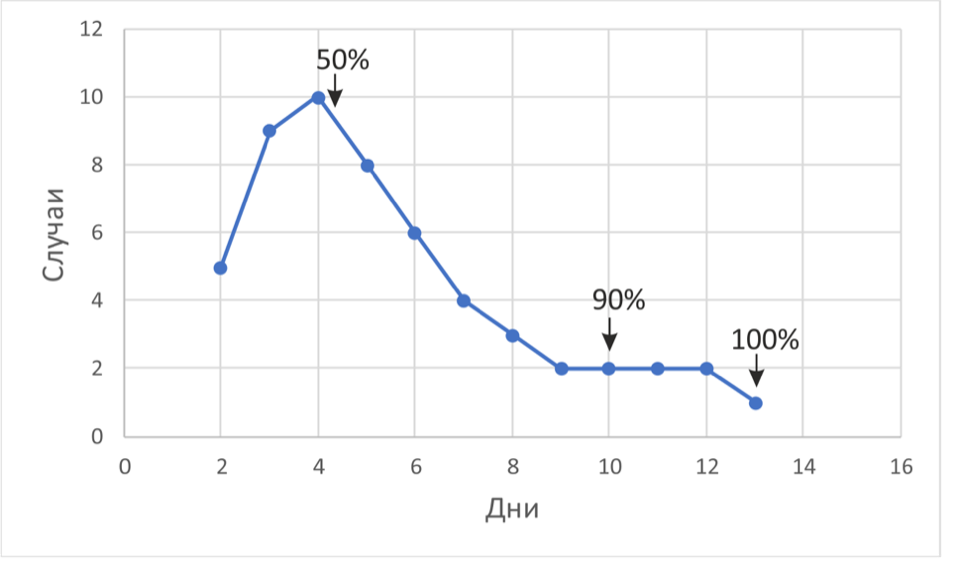
This chart shows the number of days in which the same task was completed by the same team, the number of cases, and the probability of completing it within those days. The shortest time is two days: when everything is available, no other tasks are being worked on, and there are no interruptions. But in more than 50% of cases, more than 5 days are needed.
The organization starts a new project that includes a similar task:
“How much time is needed for this task?” — the boss expects an estimate, but once we choose a specific duration, it becomes a commitment. Everyone wants to be seen as a reliable performer. Practice shows that, when planning, the duration is chosen with a 50-90% probability of on-time completion. In other words, at the task level we add a time buffer (usually over 50%) to ensure delivery on schedule.
This buffer is necessary because of the high degree of uncertainty in the project environment.
But this buffer gets lost! How?
1. Bad multitasking (task switching)
For various reasons, we switch to another task before finishing the work on the current one. For example: we have three tasks, each of which takes about an hour. If we work in a focused way, without interrupting the task, after three hours all three tasks are done. When we switch from task to task, the total time for the three tasks increases more than twofold, and the individual time for each task increases more than fivefold.
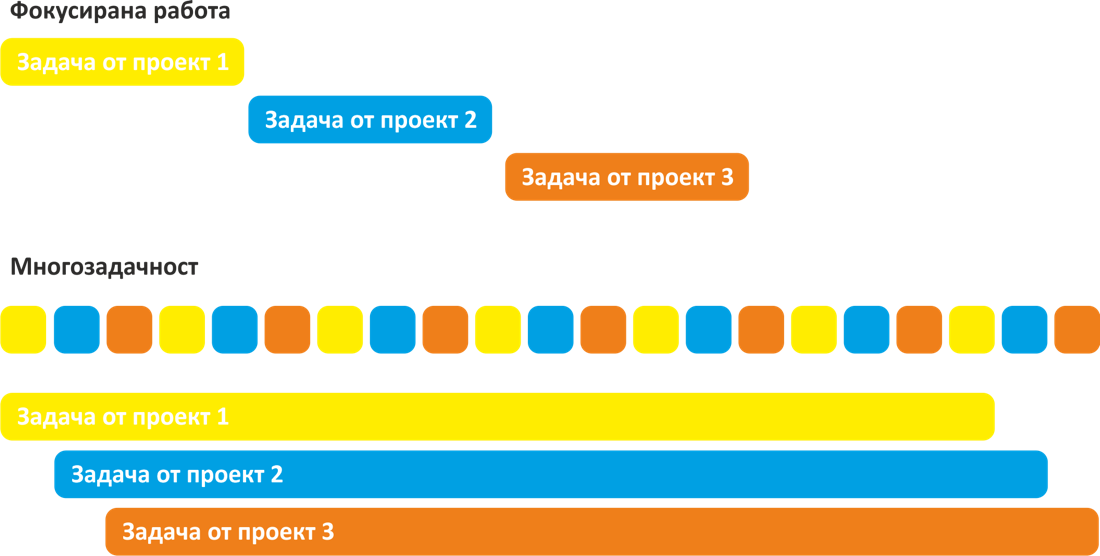
The following game shows how multitasking affects performance:
Complete three tasks: write the numbers from 1 to 20, write the letters of the alphabet from A to U, and draw 20 symbols — a circle, a square, and a triangle. First write the numbers from 1 to 20. Then write the letters, and after that the symbols. Record the time it takes to complete each of the tasks.
Then complete the three tasks again in a version closer to the way we actually work — by switching between the tasks. Write 4 digits, then write 4 letters, then draw 4 symbols. Then again: digits, letters and symbols, digits, letters and symbols — until you finish the three tasks.
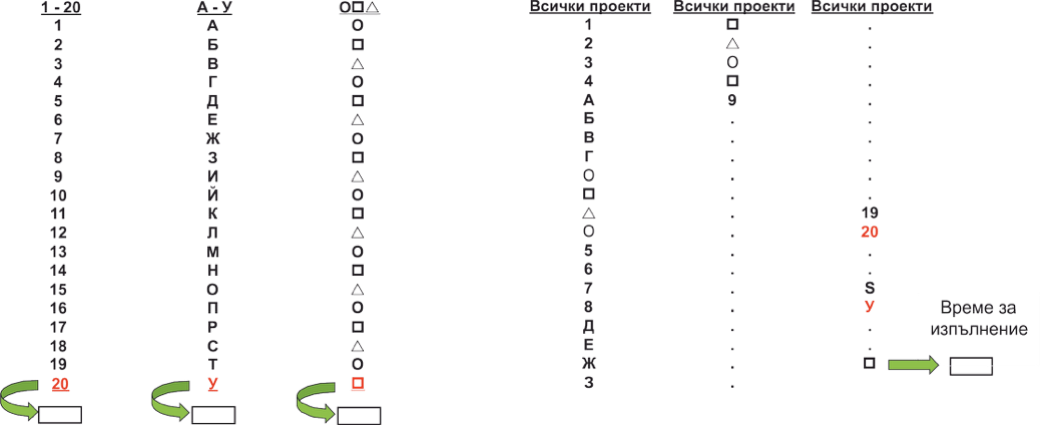
In the multitasking version, the total completion time is 1.5 to 4 times longer than the time when we worked in a focused way, and the time for an individual task is 5-8 times longer. With multitasking, tension is higher. This leads to errors, which mean adding even more time.
2. Student syndrome
When a project task reaches us for execution, at first there is no urgency. We know there is a buffer. At the same time, we are also working on other tasks. We do not immediately start working on the task at 100%. So, besides losing the buffer, the late start can cause a delay. A delay that propagates through the entire project.
3. Parkinson's Law and not reporting early finishes
Work “stretches” to fill all the time allotted for the task. If it is finished early, this is not reported, because next time we would not be given the same amount of time for such a task.
4. Murphy's Law
Everything in the project that can go wrong, goes wrong.
5. Key people doing low-skill work
A situation in which key, highly qualified people do work that is low-skill and spend a significant part of their time on it.
A solution is needed:
- one that increases the speed of all projects while meeting all specifications;
- within budget or saving costs;
- gives us a clear view of the progress of every project and timely information about projects at risk;
- provides clear priorities across projects and the organization;
- improves communication and teamwork and reduces tension and stress.
CCPM — elements of the solution
Critical chain planning
The critical chain is the longest sequence of dependent tasks and resources. The critical chain determines the duration of the project.
Example: a project with six tasks carried out by four teams. Since we do not want to build multitasking into the plan, we rearrange the tasks so that no team works on two tasks at the same time. The duration of the project is 64 days.
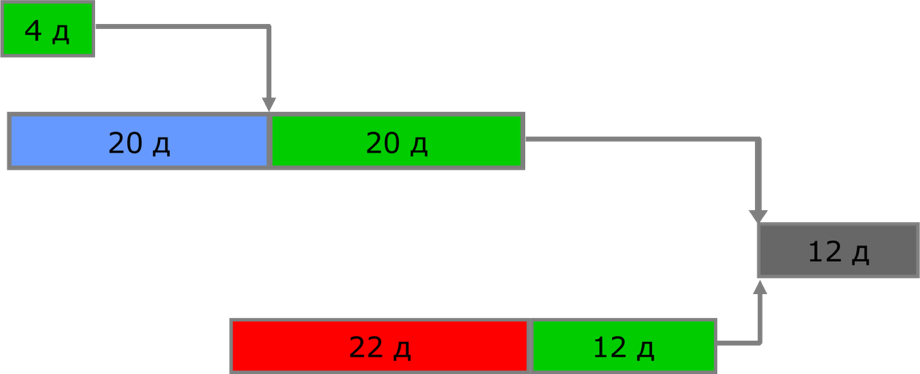
We know that every task contains at least a 50% buffer. That is why we reduce the duration of the tasks by 50% and add the remaining time to a common project buffer after the critical chain. We also add buffers to the feeding chains (the sequences of tasks that feed into the critical chain). The resulting buffers we cut in half. The CCPM plan looks like this:
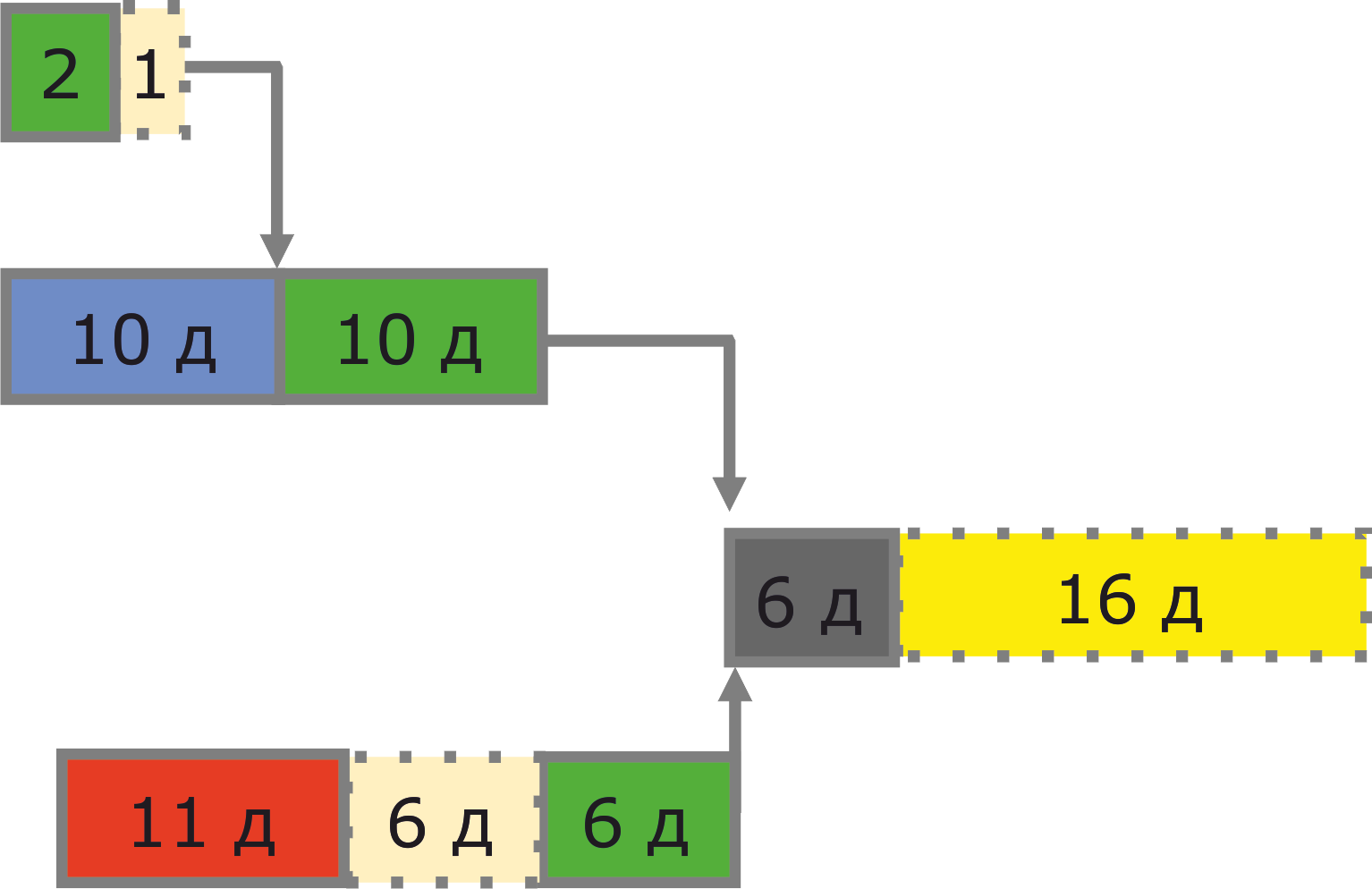
The result: the total duration is reduced by 25% compared with the original plan and is 48 days (including 16 days of buffer).
The project execution process
We create conditions for focused work and do not evaluate individual teams by whether they finish their task on time. What matters for everyone is that the project finishes on time. If the first task is 3 days late, the project eats 3 days into the buffer. The project buffer is shared by everyone and provides protection against uncertainty.
The project buffer is divided into three zones — green, yellow, and red. The percentage of buffer consumption gives us information about the state of the project and sets the priority for carrying out tasks. When the project is in the green zone of the buffer, everything about that project is fine — no special attention is needed. If the project is in the yellow zone, we prepare corrective actions, and if it enters the red zone — we apply those corrective actions.
The project fever chart
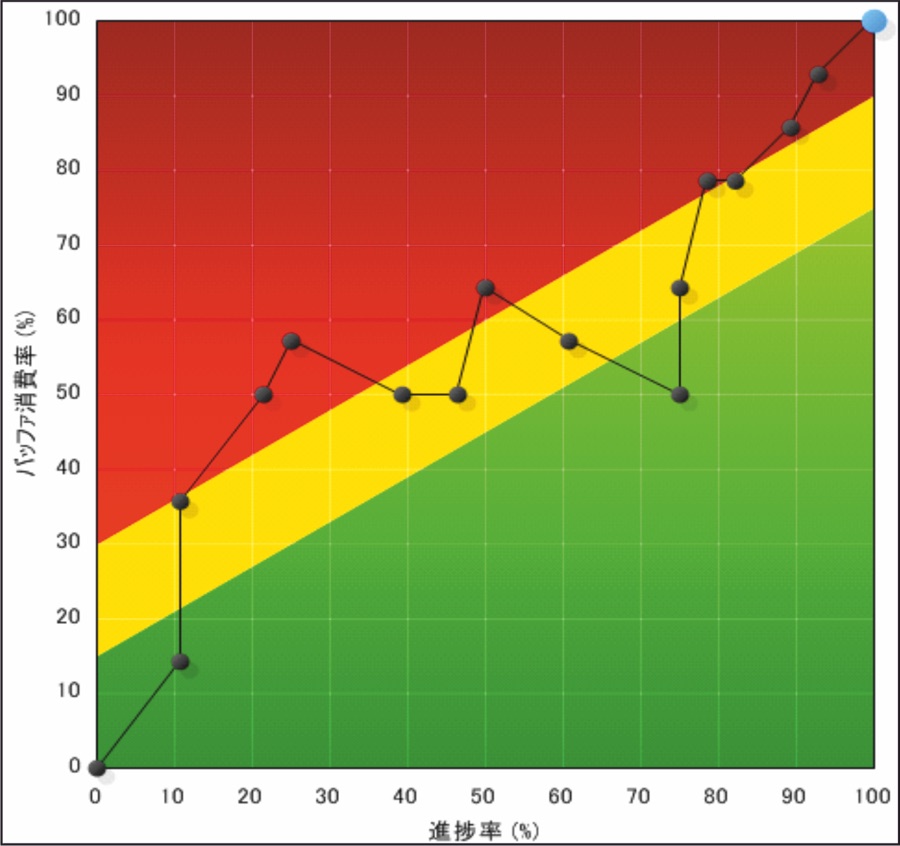
The state of the project is monitored on a “fever chart”: the horizontal axis marks the progress of the critical chain as a percentage, and the vertical axis shows the consumption of the project buffer as a percentage.
Example: a project started on time. Something happened at 10% progress of the critical chain — there is buffer consumption but no progress. Corrective actions were applied and in the end the project finished on time — 100% completion of the critical chain and 100% of the buffer consumed.
During execution, besides focused work and reduced multitasking, we must ensure a Full Kit — a project or a project task does not start before everything needed is available. It is also necessary to define what a “completed task” means, so that time is not wasted with individual teams searching for something from a previous task and interrupting their work. Priorities must be followed according to the color of the buffer, and at the end of the day the remaining time for the task must be reported.
In a multi-project environment, projects are staggered like a chessboard according to the load on the “integration phase” — the zone where several feeding chains come together. In addition, “freezing” mechanisms are used: at the level of projects, feeding chains, and tasks. Freezing temporarily reduces the number of open tasks, reduces multitasking, and significantly speeds up execution.
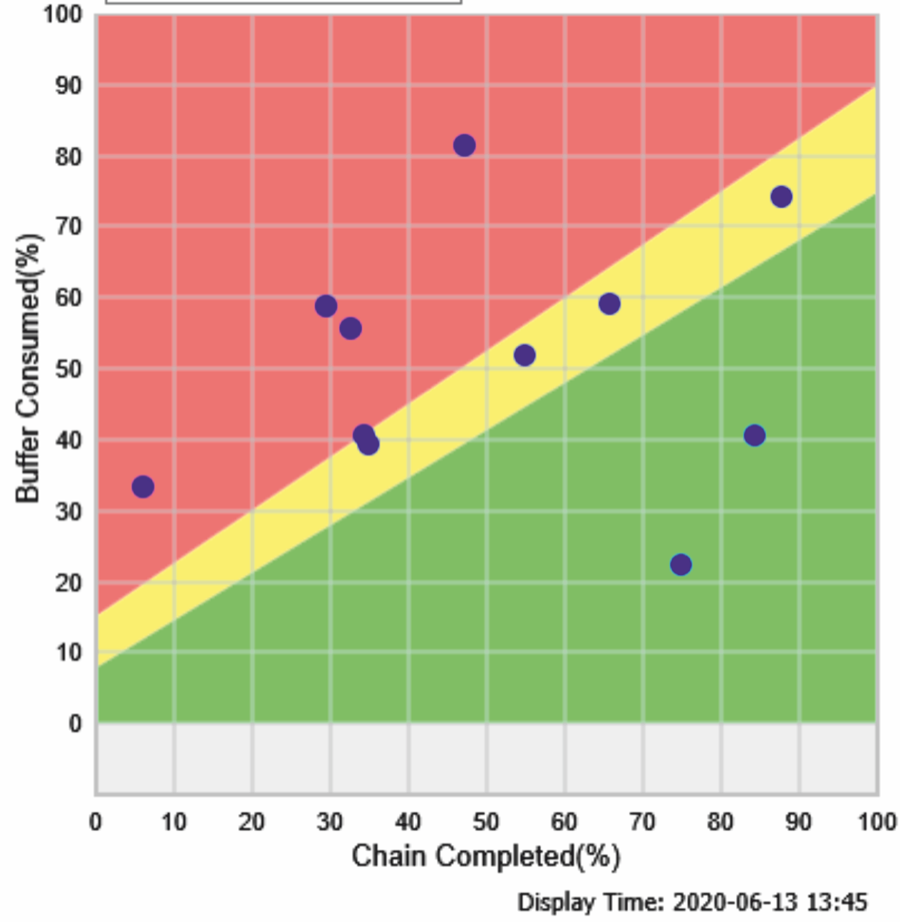
The multi-project fever chart
It shows the state of all projects in the organization. Cooperation between project managers is encouraged — resources from the “green” projects, when possible, help the endangered “red” projects.
Buffer management meetings
Depending on the environment, roughly once a week, the managers who have “red” projects take part in a “buffer management meeting” with the chief project manager. They come to this meeting with answers to the questions: “Why is my project red?” and “What will I do to recover the buffer?”. Since often only a higher-level manager can make a decision, the attitude of the chief project manager during this meeting is “How can I help you?”. For example, he can provide additional resources or a faster response from clients or suppliers.
Results
Applying CCPM — Critical Chain Project Management, based on more than 20 years of experience in many organizations around the world, delivers:
- on average a 25% shorter lead time for all projects;
- a very high level of on-time delivery;
- reduced costs;
- improved quality;
- a decisive competitive advantage;
- increased capacity;
- increased profit;
- reduced tension and stress;
- better communication, motivation, and teamwork.
About the Theory of Constraints
CCPM — Critical Chain Project Management — is a solution from the Theory of Constraints (TOC), a management methodology created by the Israeli physicist Dr. Eliyahu Goldratt. TOC is based on the understanding that the results of any system, no matter how large and complex, depend on only a few elements. Finding and properly managing the system's constraints leads to fast results, stability, and harmony.
Originally published on LinkedIn
Are your projects running late?
Contact us for a consultation and discover how CCPM can be applied in your organization.
Contact us